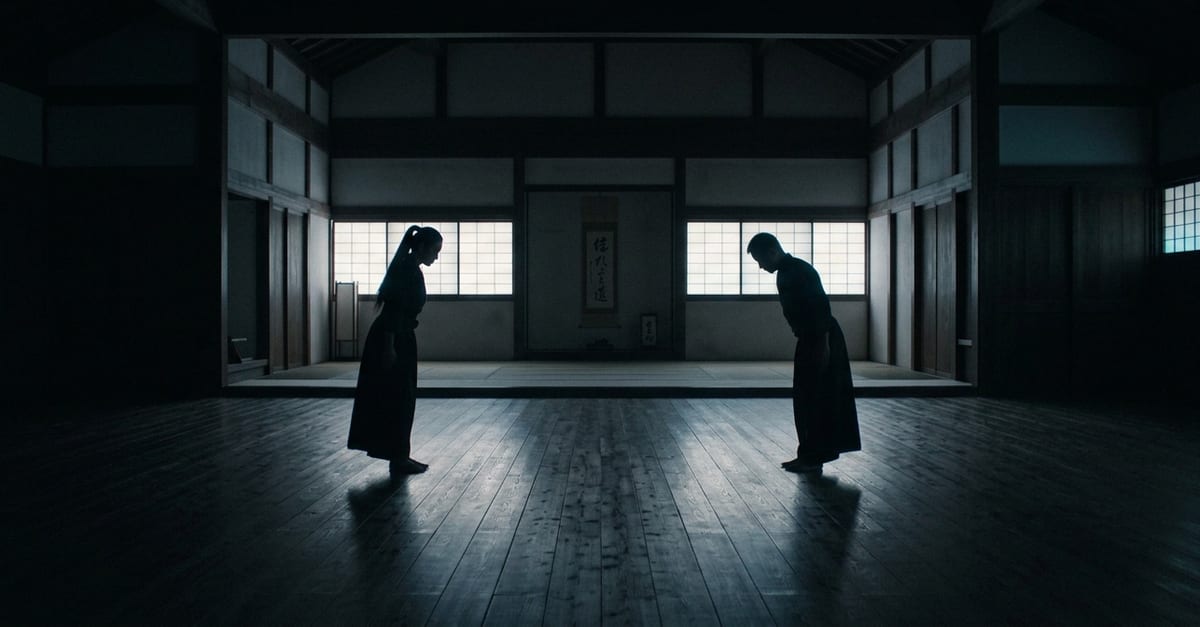
Most of us were taught that fighting is bad, and the fighting we saw seemed to prove it: fist fights at school, shouting matches in the kitchen, violent crimes on the news, name-calling in the comments. The lesson came with enforcement. We got in trouble for those fist fights and were scolded for fighting with our siblings. Schools adopt no-touching policies, societies punish and jail those who break the law, and online communities almost joyfully attack each other’s opinions.
Punishment was only half of our education, though, because nobody could keep conflict away from us either. Sooner or later we each had to face some of it in situations we couldn’t walk away from, whether it was a classmate who wouldn’t back down, a colleague who pushed back on everything, or a customer with a temper. We were left to fend for ourselves in those moments, and we had to get through them somehow. Most of us learned to avoid fighting, or to get good at it, so we wouldn’t end up in trouble or on the losing end. Both looked like wisdom.
But the lesson stopped short. We were taught to stop fighting, and we taught ourselves to survive it, when what we needed was to learn to fight maturely. As you may have observed, some adults manage the challenges of demanding careers by either creatively avoiding them or aggressively confronting them. What they could be doing instead is turning fights into opportunities for productivity, solving problems, and getting things done. There are fighting skills for that, and you probably wouldn’t recognize them as kinds of fighting at all.
Most conflict styles stop developing in adolescence
There are two broad ways to fight, with a whole spectrum of shades between them, and age isn’t the defining factor. The first is what I call adolescent fighting: the innate kind. Nobody teaches children to fight over a toy. They arrive knowing how. It is fighting to win, to be right, to come out on top, to dominate the moment, and it’s run by survival machinery rather than by choice. Plenty of fifty-year-olds fight this way in every meeting. Some teenagers have already grown past it.
In a tense meeting you can see it happening. One person argues to win the point instead of solving the problem. Another agrees to the plan, then quietly works around it afterwards. A third says “fine, do whatever you want” and stops contributing, which sounds like agreement but is withdrawal. Passive aggression is still fighting; so is going silent.
And to be clear, adolescent fighting is where every one of us starts, and it can’t be skipped any more than childhood can. The trouble is that most of us were never shown what comes after it, so we get stuck there.
How do you disagree productively at work?
Learn to see beneath the person and identify the true fight – the imbalance. Underneath most workplace disagreements sits a concrete mismatch. A broken agreement, competing priorities, strong conflicting opinions, an expectation nobody made explicit. Name that mismatch in one sentence containing no names, express what you need without pointing at the other person, and share and challenge each other’s ideas until the mismatch is resolved rather than until somebody wins.
The one-sentence discipline does most of the work. “The deadline moved twice without a conversation” is a fight worth having. You can put it on the table and examine it together. “You always do this” is an accusation, and an accusation can only be defended against. If you can’t state the imbalance without a name in the sentence, you haven’t found it yet, and the fight will happen between the two of you instead of over the issue.
Then, mid-conversation, ask yourself what the other person might be protecting. Almost every hard position guards something reasonable: a commitment made upstream, a team already at capacity, a past incident you never heard about. Sometimes it’s more personal, and the person is protecting their own feelings or their reputation. If you want to ask them directly, aim the question at the pressure they’re under, not at them. Something like “what would saying yes to this put at risk on your side?” invites information instead of defence. Either way, finding the answer usually reshapes the fight, because now you’re both looking at the same mismatch.
Fighting to restore balance, not to win
The reframe underneath all of this is the heart of mature fighting. Fight to restore balance, never to defeat a person or to win a situation. Winning is a personal victory whereas fighting for balance is a collaborative one where everyone’s asks are solved for, yours included. You manage the conflict instead of trying to defeat the person, and you live with the tension until it resolves instead of avoiding it. That makes firmness and non-aggression compatible. You can be immovable about the mismatch and easy on the human across the table, at the same time, in the same sentence. Expect it to cost something, because mature fighting always does. Staying with the discomfort instead of discharging it as anger is the price of the better outcome.
One caution: “fighting for” can turn into “fighting against” without your noticing. You can fight for quality in a way that is really a campaign against a colleague, and it will land as an attack no matter what the justification is. There’s a simple self-check. If you notice you’re rehearsing a comeback, savouring an incoming victory, or keeping score, you’ve slid back towards the adolescent end mid-conversation. Everyone does this from time to time. When it happens, don’t dwell on it. Go back to the imbalance and the one sentence with no names in it.
This spectrum, and the full range of shades between destructive and constructive fighting, is the idea my course Shades of Fighting is built around. If you’d like to explore every shade of it, I invite you to start there. You don’t have to wait for the course, though. Before your next hard conversation, write the one no-names sentence, walk in with it, and see what changes. And if you’d rather practise this live than read about it, book a free intro call.